Trading Mentorship and Your Real Edge: Risk
Uncovering Your Real Edge with Trading Mentorship
Many developing traders search tirelessly for a “holy grail”—a perfect entry signal that guarantees profit. They believe their edge lies in predicting the market's next move. However, real trading mentorship teaches a more profound truth: your edge isn't in a signal, but in how you manage risk. The signal simply tells you where to apply your risk management strategy.
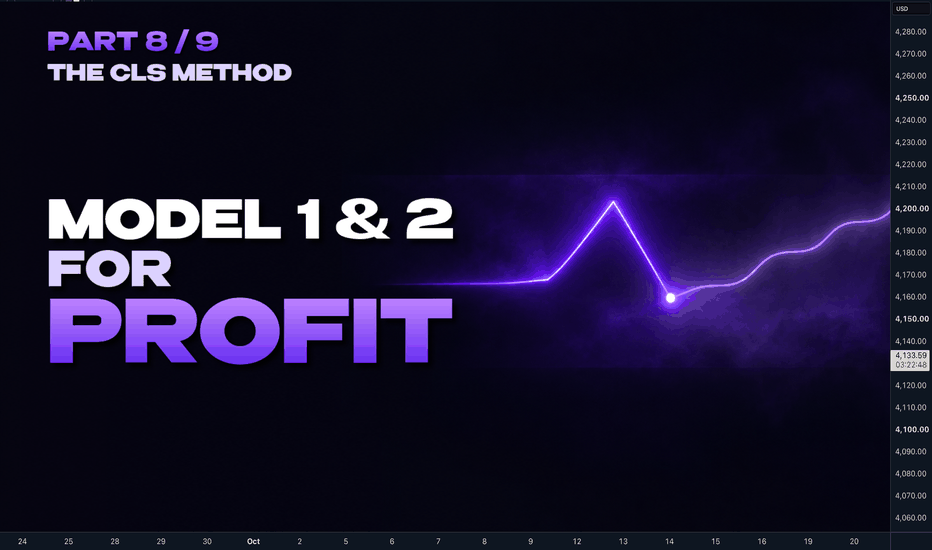
David Perk’s recent XAUUSD analysis on the 'Model 1' vs. 'Model 2' framework is a powerful lesson in risk management disguised as an entry technique. The core of the idea isn't about finding a trade; it's about systematically avoiding a bad one.
The critical mistake David points out—taking the 'Model 2' expansion trade prematurely—is a risk management failure. It's a decision based on hope and greed, not on confirmed market data. A trading coach or mentor's primary job is to help you build a process that eliminates such unforced errors, thereby protecting your capital.
How the CLS Method Manages Risk by Design
A robust trading strategy has risk management baked into its rules. It's not an afterthought. The CLS Method's distinction between the two models shows how a professional framework is designed to filter for quality and manage risk at every step.
1. The Risk of Prediction vs. Reaction
The biggest risk a trader can take is predicting what the market should do. The idea that a range, once manipulated, “has to finish” is a prediction.
- The CLS Approach: The method forces a reactive state. You do nothing until the market provides a specific piece of evidence: the candle close back inside the range. By waiting for this confirmation, you transfer the burden of proof from your prediction to the market's action. This dramatically reduces the risk of entering a trade that has no real momentum behind it.
2. Risk Management Through Trade Selection
Not all trades are created equal. The 'Model 1' reaction trade has a higher intrinsic probability than the 'Model 2' expansion trade. Why? Because the reaction is a direct response to a failed manipulation, while the expansion requires a whole new wave of momentum to break out of the other side of the range.
- The CLS Approach: Quality trading mentorship teaches you to focus your capital on the highest-probability setups. The CLS framework does this by prioritizing Model 1. You are systematically selecting the better trade and ignoring the more speculative one. This discipline is the very definition of a trading edge.
3. Controlling Risk by Defining the Trade
As David outlines in the TradingView post, the close is the “door into the first one.” This implies a single, well-defined trade with a clear start and end point: from the entry to the opposite side of the range.
- The CLS Approach: This definition contains your risk. You aren't in the trade hoping for an infinite runner. Your goal is specific and measurable. This allows for a clear reward-to-risk calculation and prevents you from letting a winning trade turn into a loser because you got greedy, hoping for the Model 2 that never came.
To begin building your own understanding of strategy-driven risk management, check out the Free CLS mini course for foundational concepts.
FAQ
H3: What is the most important part of trading risk management?
The most important part is consistency. Having a risk management plan is useless if you don't follow it on every single trade. This includes using a proper position size, always setting a stop-loss, and only taking trades that fit your predefined strategy criteria.
H3: How does a trading mentor teach risk management?
A trading mentor teaches risk management by providing a complete trading system with built-in rules. They demonstrate these rules in live markets, showing you how to select high-probability setups (and ignore bad ones), calculate position size, and manage trades from entry to exit.
H3: Can a trading coach help with psychology?
Yes, a good trading coach understands that risk management is mostly psychological. They help you identify and overcome emotional triggers like fear, greed, and FOMO that lead to poor risk decisions. This is a core component of effective forex mentorship.
Learn this with live trading signals
This is the same process David uses when he publishes trading signals in the CLS Lab membership. By joining, you not only get access to high-probability trade ideas but also join a trading community where you can see this analysis applied in real-time during live streams. Your first 5 days are free.
https://whop.com/joined/david-perk-fx/products/cls-lab-membership/
WRITTEN BY
David Perk
Full-time forex trader and mentor. $1M+ verified track record on FX Blue. Publishes CLS trading signals and teaches the process live inside the membership.
Learn more in the membership — trading signals included
Join the trading community for live CLS signals, one weekly membership stream, and the same setups you just read. First 5 days free, full access.
Start 5 days free — signals + membershipNo experience needed. Cancel anytime.