How to Use Live Trading Signals on XAUUSD
From Signal to Execution: A How-To Guide
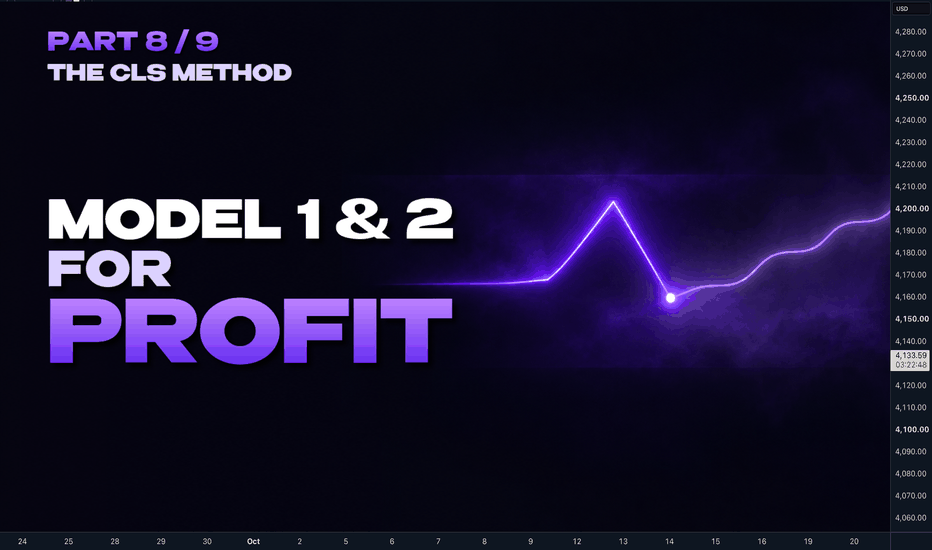
Many traders believe live trading signals are just about getting an entry, a stop-loss, and a take-profit. While those components are included, their real value lies in the strategy and context behind them. David Perk's recent XAUUSD idea about the CLS Method's 'Model 1' and 'Model 2' is a perfect example of a repeatable process you can learn to execute yourself.
Let’s walk through how to practically trade this type of structure, turning a strategic idea into a step-by-step action plan. This is how members of the CLS Lab learn to internalize the setups shared in the community, so they can begin to spot them on their own.
The core idea is to focus solely on the 'Model 1' reaction trade—the highest probability part of the sequence—and ignore the temptation of the 'Model 2' expansion until the first trade is complete.
Step-by-Step: Trading the Model 1 Reaction
Following a system is what separates guessing from professional trading. When you see live trading signals based on this CLS structure, this is the mental checklist to follow. David’s chart on TradingView gives us the blueprint.
Step 1: Establish Your Higher-Timeframe (HTF) Bias
Before looking for any entry, you need to know the market's likely direction. Is the overall trend on the daily or 4-hour chart bullish or bearish? All subsequent decisions will be filtered through this lens. If the HTF bias is bullish, you are only looking for long opportunities.
Step 2: Identify the CLS Range
A clean, obvious range where price has been consolidating is your playground. Mark the high and low of this range clearly on your chart. This is where you expect the market to react.
Step 3: Wait for the Manipulation (The 'Stop Hunt')
This is the crucial waiting game. For a bullish setup, you need to see price break below the low of the range. Amateurs see this as a bearish breakout and start selling. A professional, guided by the bullish HTF bias, recognizes this as a potential liquidity grab designed to fool the crowd.
Step 4: The Confirmation 'Close'
The entire setup hinges on this moment. You must wait for the price to not only return inside the established range but to get a candle close back inside it. As David notes, this close is your “door into the first one.” It confirms the breakdown was false and that buyers are stepping back in.
Step 5: Execute Model 1
Once you have the close, your trade is active.
- Entry: Enter the trade based on the confirming candle.
- Stop-Loss: Place your stop-loss below the low of the manipulation wick.
- Take-Profit: Your target is the opposite side of the range—the range high.
This is the complete Model 1 trade. You are not thinking about what happens at the range high. You are not hoping for a breakout. You are simply trading the reaction from one end of the range to the other.
Why This Process Matters
This step-by-step process removes emotion and guesswork. By following a clear set of rules, you avoid the primary mistake David highlights: jumping into a 'Model 2' expansion trade that hasn't even been earned yet. This disciplined approach is what a good trading mentor instills and is vital for anyone on the path to becoming a funded trader.
If this structured approach to trading seems complex, a great starting point is the Free CLS mini course, which introduces the core tenets of the strategy in a digestible format.
FAQ
H3: Are live trading signals good for learning?
Absolutely. The best live trading signals are educational. They should come with charts and analysis that explain the 'why' behind the trade. This allows you to learn the strategy in a live market environment, which is far more effective than just studying theory.
H3: How do I find a good forex signal service?
A good forex signal service is run by a transparent trader with a verified track record. They should focus on a consistent strategy, provide clear analysis with their signals, and foster a trading community where you can ask questions and learn.
H3: Can I become a funded trader using signals?
Yes, but not by blindly copying. Use signals to master a specific, proven strategy. The discipline and risk management taught by a professional signal provider are exactly the skills that prop firms look for. You use the signals to build your own consistency, which is the key to getting funded.
Learn this with live trading signals
This is the same process David uses when he publishes trading signals in the CLS Lab membership. By joining, you not only get access to high-probability trade ideas but also join a trading community where you can see this analysis applied in real-time during live streams. Your first 5 days are free.
https://whop.com/joined/david-perk-fx/products/cls-lab-membership/
WRITTEN BY
David Perk
Full-time forex trader and mentor. $1M+ verified track record on FX Blue. Publishes CLS trading signals and teaches the process live inside the membership.
Learn more in the membership — trading signals included
Join the trading community for live CLS signals, one weekly membership stream, and the same setups you just read. First 5 days free, full access.
Start 5 days free — signals + membershipNo experience needed. Cancel anytime.