Live Trading Signals: A Step-by-Step Entry Guide
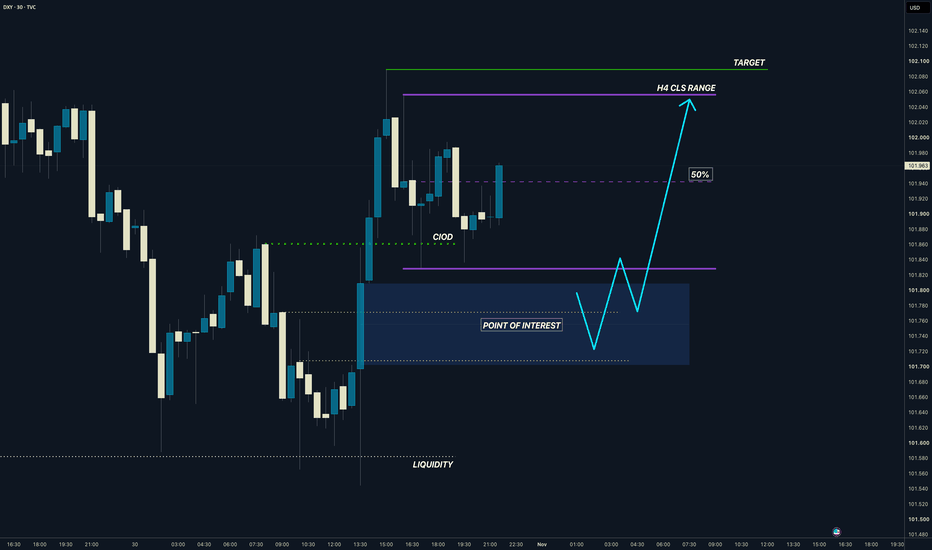
From Chart Analysis to Trade Execution
A detailed chart analysis, like the recent DXY idea, is a powerful road map. But a map is useless if you don't know how to follow it. The real skill lies in translating that plan into a live trade. This is where live trading signals and a structured process become invaluable. Many traders see a blue box on a chart and impulsively place an order, but a professional's execution is far more deliberate.
Let’s walk through the practical, step-by-step process of trading this DXY setup. This is the same methodical approach members of our trading signals membership learn to apply, turning static ideas into dynamic, managed trades.
This analysis was originally posted on TradingView: DXY H4 CLS range formed - POI
Step 1: Define the Higher Timeframe (HTF) Narrative
Before even thinking about an entry, you must understand the bigger picture. The analysis clearly identifies an H4 CLS range with a bullish objective. This is your governing bias.
- Action: Acknowledge the overall direction is up.
- Rule: You are only looking for long (buy) positions. All shorting ideas are ignored until the HTF narrative changes.
This single step filters out at least 50% of all bad decisions. Following a source of quality forex signals helps reinforce this discipline, as the provided analysis always starts with the HTF context.
Step 2: Mark the Key Zone and Set Your Alerts
The plan pinpoints a blue Point of Interest (POI) where a pullback is expected. This is your area of focus.
- Action: Draw the same zone on your own chart. Your goal is not to blindly copy, but to understand why that zone was chosen. It's an area of institutional interest.
- Crucial Sub-step: Set an alert for when price enters this zone. You cannot watch the charts 24/5. Alerts are your best friend—they free you from screen time and prevent emotional, impatient decisions.
Step 3: Wait Patiently for the Lower Timeframe (LTF) Confirmation
This is where most traders fail. Once price touches the POI, the temptation to jump in is immense. The plan, however, explicitly states: "Point of Interest ≠ Automatic Entry." Your job is to switch to a lower timeframe (like the 1-minute or 5-minute chart) and wait for a specific pattern to unfold.
- Action: Watch for a liquidity sweep (a quick stab below a recent low), a strong close back inside the range, and a subsequent break of a small bearish swing point (a change of character).
- Mindset: You are a hunter, not a gambler. You are waiting for the target to present the perfect shot. If the pattern doesn't form, there is no trade. You lose nothing.
How Live Trading signals Bridge the Gap
Executing this multi-step process requires discipline. In the CLS Lab, members receive live trading signals that guide them through this process.
- The Idea: The initial analysis (like this DXY chart) is shared, setting the stage.
- The Alert: When price approaches the POI, I'll often send an update in the community: "Watching DXY now for the LTF confirmation."
- The Signal: If and only if the exact LTF entry model forms, the final signal is sent with a precise entry, stop loss, and take profit.
This structure helps traders build the habit of patience and confirmation. You see the process unfold in real-time, guided by a mentor and reinforced by the trading community.
FAQ
H3: What is the difference between a trade idea and a live signal?
A trade idea is a high-level plan or analysis, like this DXY chart, outlining a potential scenario. A live trading signal is an actionable alert, sent in real-time when the specific entry conditions of that plan have been met, providing exact entry, stop, and target levels.
H3: How fast are live trading signals delivered?
Effective signal delivery is instant. In the CLS Lab, signals are sent through a dedicated Discord server with notifications, ensuring members receive the information immediately. Speed is critical because the precise entry window for a confirmation model can be brief.
H3: Do I need to be at my charts all day to use signals?
No. A key benefit of a good signal service is that the provider does the heavy lifting of watching the market. You can set alerts for key zones as discussed, and then wait for the final signal to be sent, allowing you to engage with the market only when a high-probability opportunity is present.
Learn this with live trading signals
This is the same structured, patient, and confirmation-based process I use when I publish trading signals for members in the CLS Lab. Inside, you'll join a professional trading community where you get access to my live analysis, trade ideas, and direct mentorship through our live streams. If you're ready to see how this works in real-time, you can join today and get your first 5 days free.
WRITTEN BY
David Perk
Full-time forex trader and mentor. $1M+ verified track record on FX Blue. Publishes CLS trading signals and teaches the process live inside the membership.
Learn more in the membership — trading signals included
Join the trading community for live CLS signals, one weekly membership stream, and the same setups you just read. First 5 days free, full access.
Start 5 days free — signals + membershipNo experience needed. Cancel anytime.