Capital First: Risk Control in an AUDUSD Trade Setup
The Real Edge in Trading Isn't What You Think
Many aspiring traders believe the key to success lies in a secret indicator or a flawless entry signal. While a robust strategy is crucial, the true differentiator between consistent profitability and blowing accounts is something far less glamorous: risk management. In professional trading, your first and most important job is not to make money, but to protect the capital you already have.
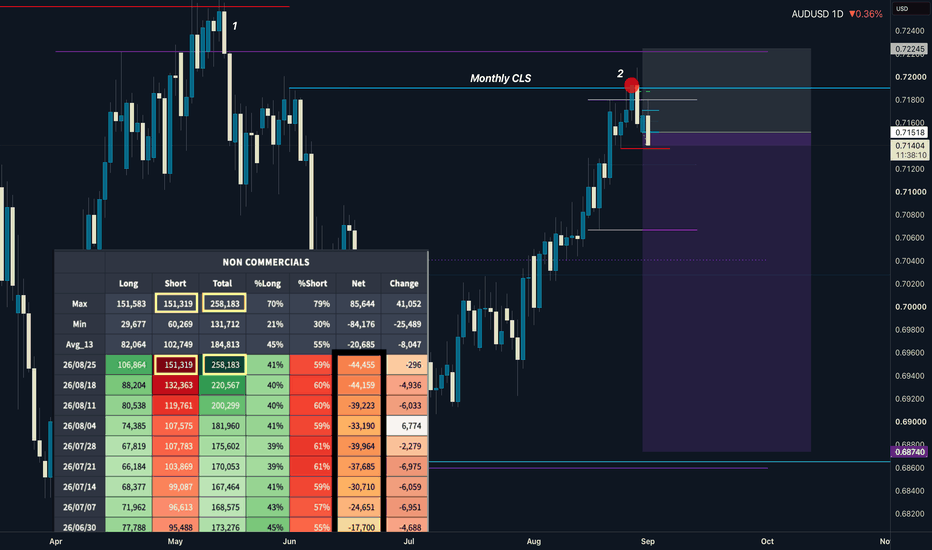
A recent trade idea on AUDUSD serves as a perfect case study for how a professional trader approaches the market with a defense-first mindset. The focus isn't just on the potential reward, but on a structured process that controls risk at every step.
A Framework for Capital Protection
In the analysis of the AUDUSD chart, before any mention of targets or entries, a clear set of risk principles was established. This isn't an afterthought; it's the foundation upon which the entire trade is built. Let's break down these core tenets.
1. Protect Capital First
This is the golden rule. Every decision must be filtered through the lens of capital preservation. For a retail trader, and especially a funded trader managing a large account, a significant loss can be a career-ending event. By prioritizing capital protection, you ensure you can stay in the game long enough for your strategic edge to play out over a series of trades. It shifts the focus from chasing one big win to achieving long-term consistency.
2. Define Your Risk Before Entry
The idea emphasizes the need to "Always place a proper stop loss." A stop loss is not a sign of weakness or an admission that you might be wrong. It is a calculated business decision. Before entering the trade, you determine the exact price point at which the trade idea is invalidated. This allows you to quantify the maximum potential loss on that single trade, ensuring it's a small, manageable percentage of your total account. This single practice is a cornerstone of quality forex education.
3. Patience as a Risk Management Tool
Impatience is expensive. The AUDUSD setup explicitly states, "Stay patient and enter only after candle close." Why? Because entering prematurely, before the market has confirmed your thesis, is gambling. Waiting for specific confirmations—in this case, a Change in Order Flow (CIOD) after a manipulation phase—is a form of risk control. It filters out lower-probability setups and reduces the chances of being caught in market noise. A great trading coach will always emphasize process over impulse.
The Psychology of Disciplined Trading
Managing risk is as much a psychological discipline as it is a technical one. The principles of staying disciplined and avoiding emotional trading are critical. When you have a clear plan, a defined risk, and a valid strategy like the CLS strategy, it becomes easier to execute without fear or greed clouding your judgment.
You are instructed to "Take the Trade only if you understand the logic behind it." This empowers you as a trader. You're not blindly following signals; you're engaging with a logical framework. This understanding builds the conviction needed to manage the trade correctly, from entry to exit, without emotional interference.
Ultimately, this AUDUSD analysis demonstrates that a professional approach is a holistic one. It combines a high-probability setup with an unwavering commitment to risk management. This is the real edge that our trading academy instills in every student.
WRITTEN BY
David Perk
Full-time forex trader and mentor. $1M+ verified track record on FX Blue. Teaches the CLS strategy to funded traders — live, five times a week.
Want to trade this alongside David?
Join the community — livestreams 5× a week, trade breakdowns, and entries called in real time. Your first week is free, full access to every paid feature.
Join the community — first week freeNo experience needed. Cancel anytime.