A Beginner's Guide to the CLS Strategy on USOIL
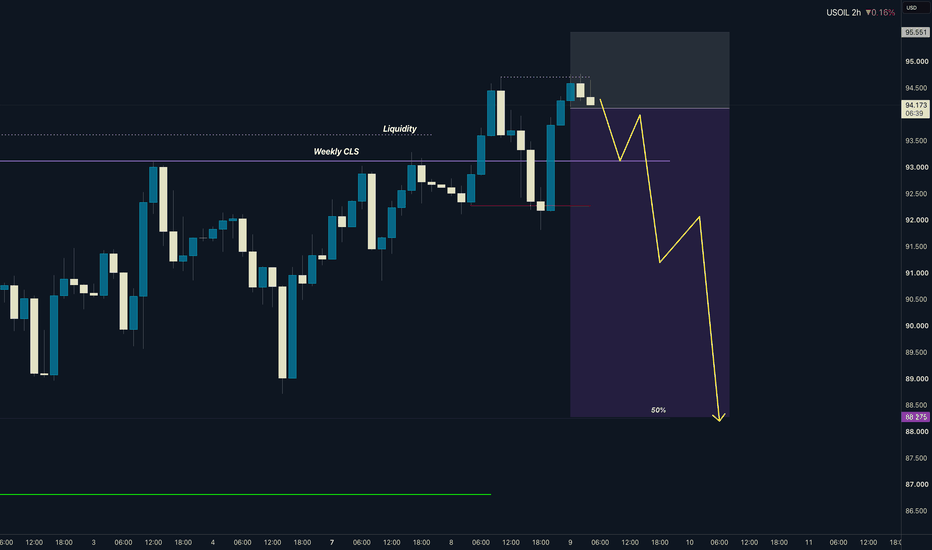
Understanding Professional Trade Setups
Many aspiring traders look at a chart and see random price movements. A professional, however, sees a story of supply and demand, structure, and opportunity. A recent analysis of USOIL provides a perfect example of a structured approach, using what we call the CLS strategy. For anyone starting their forex education journey, understanding the principles behind such a setup is far more valuable than just seeing a potential trade.
This isn't about blindly following a signal; it's about learning to read the market's language. Let's break down the core concepts from this USOIL idea to build a solid educational foundation.
The Building Blocks of a CLS Trade
The foundation of this setup is the "CLS Range." Think of this as a clearly defined price zone where the market has been consolidating. It's the battlefield where buyers and sellers have established a temporary balance. The first step in this strategy is to identify this range on a higher timeframe, as it provides the context for our entire trade idea.
Once the range is set, the strategy waits for a specific event: manipulation.
What is Manipulation?
In the context of the CLS strategy, manipulation is a price move that pushes outside of the established range, often into a key level of support or resistance. In the USOIL example, the idea looks for price to move below the CLS range. To an untrained eye, this might look like a breakout to the downside. However, experienced traders recognize this as a potential move to trigger stop losses and trick participants into taking the wrong side of the market. The strategy anticipates that this move is false and that price will reverse back into the range.
The Power of Patience and Confirmation
Identifying the range and the manipulation is only half the battle. The most critical part for anyone looking to learn forex trading is waiting for confirmation. A professional doesn't just guess that the manipulation is over; they wait for the market to prove it.
This proof comes in two forms mentioned in the analysis:
- Change in Order Flow (CIOD): After the dip below the range, we need to see the market's internal momentum shift back to the upside. This "change in order flow" signals that buyers are stepping back in and overpowering the sellers who pushed the price down. It's the first clue that the manipulation phase is ending.
- Candle Close: A definitive entry signal is a candle closing back inside the CLS range. This confirms the reversal and validates the entire trade idea. Entering before a confirming candle close is gambling; entering after is executing a plan.
By following a structured process—identifying a range, waiting for manipulation, and confirming the reversal with a CIOD and candle close—a trader moves from guessing to executing a high-probability model. This is the cornerstone of effective forex education and the key to building long-term consistency.
WRITTEN BY
David Perk
Full-time forex trader and mentor. $1M+ verified track record on FX Blue. Teaches the CLS strategy to funded traders — live, five times a week.
Want to trade this alongside David?
Join the community — livestreams 5× a week, trade breakdowns, and entries called in real time. Your first week is free, full access to every paid feature.
Join the community — first week freeNo experience needed. Cancel anytime.